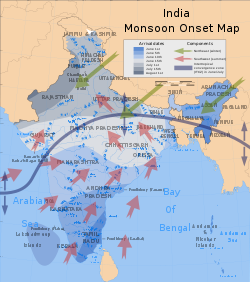
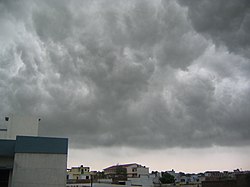
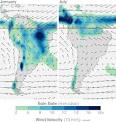
There are several places around the world where a monsoon can occure. These places are: North America, Asia, India, Africa, and Europe. The reason that these monsoons happen is for several variables to line up just right. These variables inlude heated air from land, and heated air over the seas. Or instead of heat, it could be rapid cooling. The air that flows over the land heats up quicker than the water which causes a low pressure zone. This low pressure zone pulls air from off an ocean creating a jest of wind. This jet of wind usually carries the rains produced over the ocean. This in turn, crates extreme rainfall known as a Monsoon. The monsoons can impact the enviroment significantly. The monsoons can be either good or bad. The good part of it is if (for example) there was a drought, soil will once again be hydrated and can water crops. The bad part is damage. Monsoons can cause much destruction in civilized areas. The Monsoons causing damage can effect people and economy. When the damage is over, millions of dollars in property damage is caused. Also, the monsoons can kill people by collapsing buildings, trees, etc.(1)
The Strong Monsoon Signal is issued when winds associated with the summer or winter monsoon are blowing in excess of or are expected to exceed 40 kilometres per hour. (2) The types of technology they use to predict the monsoons are SATALITES, WIND GUAGES, and RAIN CATCHERS.(3)






(1)Wikipedia. (2011, October 13). Monsoon [Web log message]. Retrieved from http://en.wikipedia.org/wiki/Monsoon
(2)Hong Kong, . "Monsoon Warnings." Monsoon warning times. n. d. Web. 20 Oct. 2011. <http://www.hko.gov.hk/wservice/warning/smse.htm>.
(3)Hong Kong, . "Monsoon Statistics." Statistics. 23 Jun 2011. Web. 20 Oct. 2011. <http://www.weather.gov.hk/education/edu01met/wxphe/ele_rainstorm05_e.htm>.


