Tuesday, November 22, 2011
Sunday, November 6, 2011
My Space Objects Powerpoint
Please Click on the link below to check out my Black Hole Powerpoint!https://docs.google.com/present/edit?id=0ATHaYEEgG4sXZGQzNGZwcDNfMGN3dGM3d2Z6

Friday, October 21, 2011
MSU Trip
1. At the planetarium, I learned many things. The first thing is that there is a black hole in the center of each galaxy that holds them together. I also learned that there are many types of galaxies. Some types are Olyptical, Spiral, and Peculiar. A third thing I learned was that you can see many planets like Mars from Earth. One fourth thing was that you can see different constellations at diffent times/seasons. Last thing I learned is that galaxies can collied, but not harm eachother.
2. The cyclotron creates new ions out of the known elements. They can control which ions get sent to the recorder, and get rid of the other ions. Last thing I learned about the cycloton is that they generally run it for 5 days at a time, and only get a few of the ions they want.
3. The two things that I enjoyed
2. The cyclotron creates new ions out of the known elements. They can control which ions get sent to the recorder, and get rid of the other ions. Last thing I learned about the cycloton is that they generally run it for 5 days at a time, and only get a few of the ions they want.
3. The two things that I enjoyed
Tuesday, October 18, 2011
Monsoon
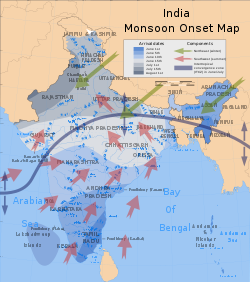
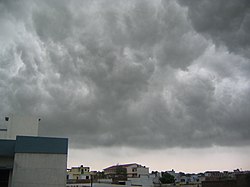
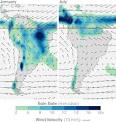
There are several places around the world where a monsoon can occure. These places are: North America, Asia, India, Africa, and Europe. The reason that these monsoons happen is for several variables to line up just right. These variables inlude heated air from land, and heated air over the seas. Or instead of heat, it could be rapid cooling. The air that flows over the land heats up quicker than the water which causes a low pressure zone. This low pressure zone pulls air from off an ocean creating a jest of wind. This jet of wind usually carries the rains produced over the ocean. This in turn, crates extreme rainfall known as a Monsoon. The monsoons can impact the enviroment significantly. The monsoons can be either good or bad. The good part of it is if (for example) there was a drought, soil will once again be hydrated and can water crops. The bad part is damage. Monsoons can cause much destruction in civilized areas. The Monsoons causing damage can effect people and economy. When the damage is over, millions of dollars in property damage is caused. Also, the monsoons can kill people by collapsing buildings, trees, etc.(1) The Strong Monsoon Signal is issued when winds associated with the summer or winter monsoon are blowing in excess of or are expected to exceed 40 kilometres per hour. (2) The types of technology they use to predict the monsoons are SATALITES, WIND GUAGES, and RAIN CATCHERS.(3)






(1)Wikipedia. (2011, October 13). Monsoon [Web log message]. Retrieved from http://en.wikipedia.org/wiki/Monsoon


(1)Wikipedia. (2011, October 13). Monsoon [Web log message]. Retrieved from http://en.wikipedia.org/wiki/Monsoon
(2)Hong Kong, . "Monsoon Warnings." Monsoon warning times. n. d. Web. 20 Oct. 2011. <http://www.hko.gov.hk/wservice/warning/smse.htm>.
(3)Hong Kong, . "Monsoon Statistics." Statistics. 23 Jun 2011. Web. 20 Oct. 2011. <http://www.weather.gov.hk/education/edu01met/wxphe/ele_rainstorm05_e.htm>.
Monday, October 3, 2011
Great Lakes Regional Context
The biggest lake in terms of volume is Lake Superior. The smallest is Lake Ontario.
The most urban lake is Lake Erie. The most rural lake that Michigan has is Lake Superior.
The lake with the most shoreline is Lake Huron.
If we keep watching how we use the lakes, We can better conserve the water in our lakes. We also need to keep a close eye on how many pollutants we are dumping into the waters. The more we mess with the lakes, the worse the ecosystem will be.
Two pollutants that pertain to our action project are CO2 emissions, and oil from drilling that runs off into our waters.
PRELIMINARY QUESTIONS
The water from our house usually goes through a system of sewer drains, and waste management facilities then gets dumped into our lakes.
Runoff water is the excess water that flows over land, usually picking up pollutants or sediments dropping them into places like lakes or streams.
In more urban areas, the answer is yes. I don't think they should go to the same place, due to the fact that the runoff water is generally cleaner than the sewage water.
Sources of pollution are sediments, or gas from roads, animal droppings or bodies, etc.
Point source is when something like a factory directly pumps pollutants into the water system. Non-point is when something like gas or oil from cars sits in a parking lot and then runs off into the water system.
The most urban lake is Lake Erie. The most rural lake that Michigan has is Lake Superior.
The lake with the most shoreline is Lake Huron.
If we keep watching how we use the lakes, We can better conserve the water in our lakes. We also need to keep a close eye on how many pollutants we are dumping into the waters. The more we mess with the lakes, the worse the ecosystem will be.
Two pollutants that pertain to our action project are CO2 emissions, and oil from drilling that runs off into our waters.
PRELIMINARY QUESTIONS
The water from our house usually goes through a system of sewer drains, and waste management facilities then gets dumped into our lakes.
Runoff water is the excess water that flows over land, usually picking up pollutants or sediments dropping them into places like lakes or streams.
In more urban areas, the answer is yes. I don't think they should go to the same place, due to the fact that the runoff water is generally cleaner than the sewage water.
Sources of pollution are sediments, or gas from roads, animal droppings or bodies, etc.
Point source is when something like a factory directly pumps pollutants into the water system. Non-point is when something like gas or oil from cars sits in a parking lot and then runs off into the water system.
Our D.O. Lab
The Q-Value that we had during our Dissolved oxygen test was 110%. This Q value was a little bit high but is still good for our river. It is high enough to support plenty of life. Luckily it isn't high enough to damage the ecosystem and kill off all the plants and animals. Our overall Q-Value for our D.O. test in the river was: . I didn't expect this value due to the fact that our river flows so slowly, that the air wouldn't get into the water very easily. Our project can neutralize the Q-Value by just adding the correct amount of oxygen to H2 ratio.
Subscribe to:
Posts (Atom)